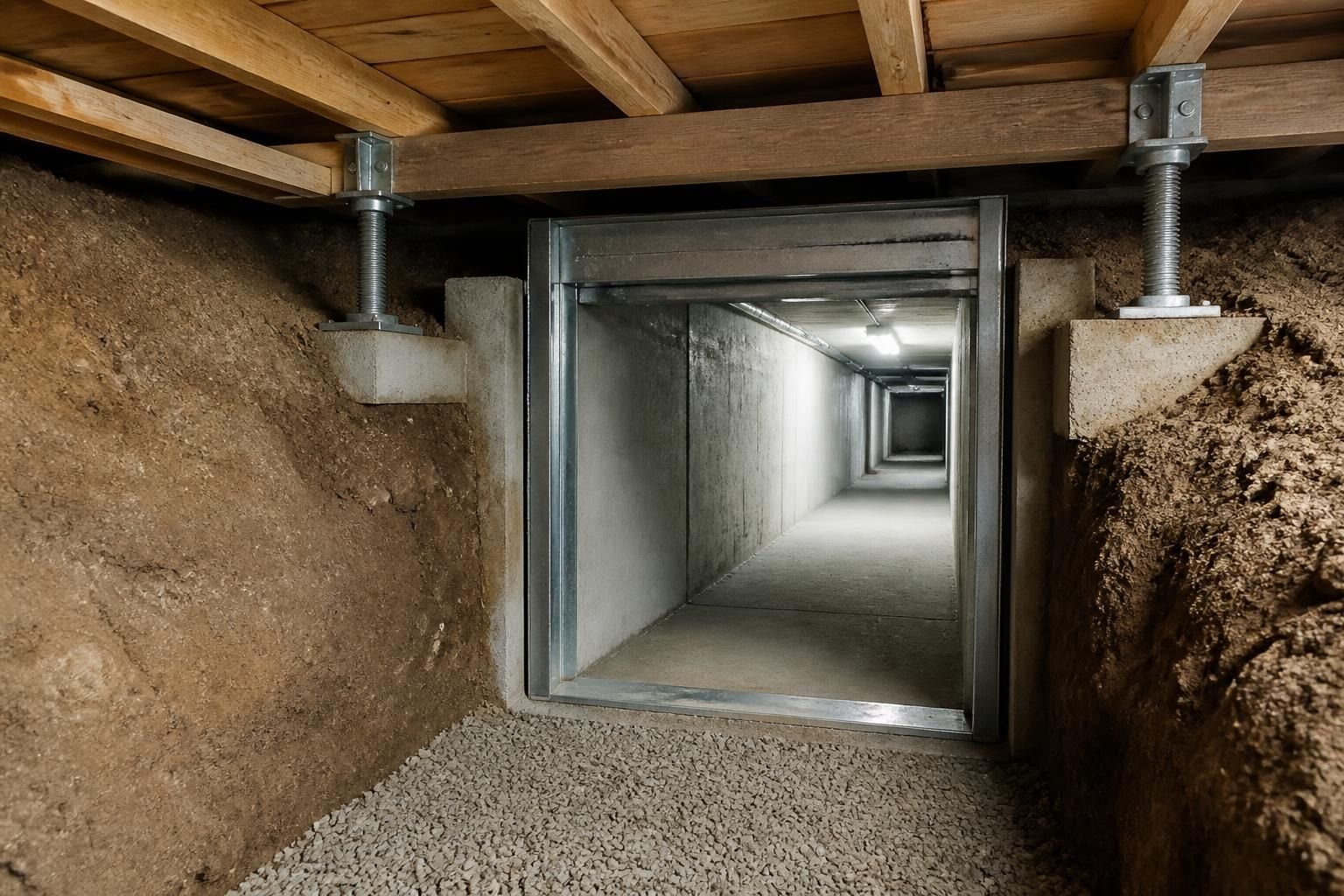
Sugar Land Solid Foundation Repair offers tunneling services in Sugar Land, TX. If your floors have started to slope, your doors are sticking, or cracks keep coming back after patchwork repairs, the problem may be beneath the slab. Many Sugar Land homes sit on soil that moves with moisture changes, and that movement can create foundation damage that needs access from below rather than from inside the house.
That is where tunneling can help. Sugar Land Solid Foundation Repair uses tunneling services to reach the area under a foundation without tearing through finished rooms, making it possible to address the source of the problem while keeping disruption to a minimum. If you are seeing signs of settlement, shifted supports, or damage that points to a deeper structural issue, we can inspect the home and explain whether tunneling is the right path.
Tunneling is used when repair work must be done under a slab or another hard-to-reach area. Instead of cutting through floors, a tunnel is created outside the home so access can be made beneath the foundation. For many Sugar Land properties, that approach is useful when a support needs adjustment, a damaged area must be reached, or a repair has to be made without disturbing the interior more than necessary.
As Sugar Land Solid Foundation Repair evaluates a property, we look for the source of the movement, not just the visible symptom. If the issue is tied to soil movement, poor drainage, or a support problem under the slab, tunneling may provide the access needed to complete the work cleanly and efficiently.
Foundation movement rarely shows up all at once. It usually starts with small changes that become easier to ignore than they should be. If you notice several of the signs below, it may be time to have the structure checked.
Hairline cracks can happen for many reasons, but cracks that keep reappearing after patching often suggest ongoing movement below the slab.
A floor that slopes, dips, or feels different from room to room can point to settlement or support loss beneath the home.
Doors and windows that suddenly bind, scrape, or leave uneven gaps often reflect shifting framing caused by foundation movement.
Gaps along baseboards, crown molding, or wall joints can be a sign that the structure is shifting away from its original position.
These symptoms do not always mean tunneling is needed, but they do mean the home deserves a closer look. A careful inspection helps identify whether access from below will solve the issue or whether another repair approach is more appropriate.
Tunneling is a targeted method. The goal is to reach the affected area under the foundation with the least amount of surface disturbance needed to complete the repair. We start by locating the area of concern, then plan the tunnel path so the work can be done safely and efficiently.
We examine the visible signs, review how the home is moving, and determine where subsurface access is needed.
The tunnel route is planned to reach the repair area while avoiding unnecessary disruption to landscaping and exterior features.
A tunnel is created from the exterior so the repair point under the slab can be reached.
The foundation work is completed from the tunnel, whether that means reaching supports, correcting a damaged area, or preparing the space for another repair method.
Once the work is complete, the tunnel is filled back in and the site is restored as part of the process.
Because the access is created outside the home, tunneling can be a practical option when interior demolition would be disruptive or when the repair area is simply not reachable any other way.
Tunneling is often considered for slab foundation repair, house leveling work, and repairs that need direct access under the structure. It can also be useful when a home has a problem area near an interior wall, a support point, or another location where top-side access would mean cutting through finished surfaces.
For Sugar Land homes, this matters because many foundation problems are tied to the clay soil under the property. When soil swells and shrinks, it can shift the slab and place stress on the structure. In some cases, the repair must happen below the home to reach the area affected by that movement.
One of the main reasons homeowners ask about tunneling is simple: they want the repair to be handled without creating unnecessary damage inside the home. Tunneling can reduce the need to remove flooring, cut through interior rooms, or disturb areas that are already finished and lived in.
That said, tunneling is not a shortcut. It is a method chosen when the repair calls for subsurface access and when exterior entry is the cleaner path. If a repair can be addressed another way, we will explain that too. The goal is to match the method to the actual structure problem, not force the same approach on every house.
Before any tunnel work begins, the inspection matters. We look at the visible symptoms, the condition of the slab or support system, and the likely source of movement. That helps us avoid guessing and gives you a clearer idea of what the home needs.
At Sugar Land Solid Foundation Repair, we use that information to decide whether tunneling is the right way to reach the repair area. If it is, we explain the access point, the scope of work, and what the process will involve before anything starts.
Tunneling can sound unfamiliar if you have never dealt with a foundation repair before. Most questions come down to access, disruption, and what the process means for the rest of the property. A clear explanation makes it easier to decide whether the method fits the problem.
That is one of the main reasons homeowners consider it. Tunneling is designed to reach the repair area from outside the home, which can help avoid cutting through interior flooring and finished rooms.
No. It is used when the repair area is beneath the slab and direct access from below is the most practical option. Some foundation problems can be handled through other methods.
If recurring cracks are caused by movement under the foundation, tunneling may provide the access needed to address the source rather than just the surface damage.
It can, especially when the structure has pier and beam features or when a repair point is difficult to reach from inside. The right method depends on the home’s layout and the damage pattern.
The tunnel is backfilled after the work is complete. The site is then restored as part of the process so the access point does not remain open.
The best way to know is through an inspection. We look at the symptoms, the structure, and the likely cause of movement, then explain whether tunneling makes sense for your home.
If your Sugar Land home is showing signs of foundation movement and you want a repair method that reaches the problem without unnecessary interior disruption, tunneling may be the answer. Sugar Land Solid Foundation Repair can inspect the property, explain what is happening beneath the slab, and recommend a practical next step.
Related services include Foundation Inspection.
We serve homeowners across Sugar Land, including New Territory, Telfair, and First Colony.
Call +13464205260 to Schedule an inspection and we will help you fix your foundation problems.
When under-slab plumbing leaks beneath a Sugar Land home, the escaping water saturates the Beaumont clay and drives localized heave and movement. Tunneling lets us reach and repair those lines from beside and beneath the foundation instead of jackhammering through your finished floors. On reactive Fort Bend clay, keeping the slab intact also avoids introducing new weak points, which is why access-tunneling is often the better route here.

Start With an Inspection
Share the signs you have noticed, and we will help you determine whether the issue points to slab movement, settling, drainage trouble, or another foundation concern.